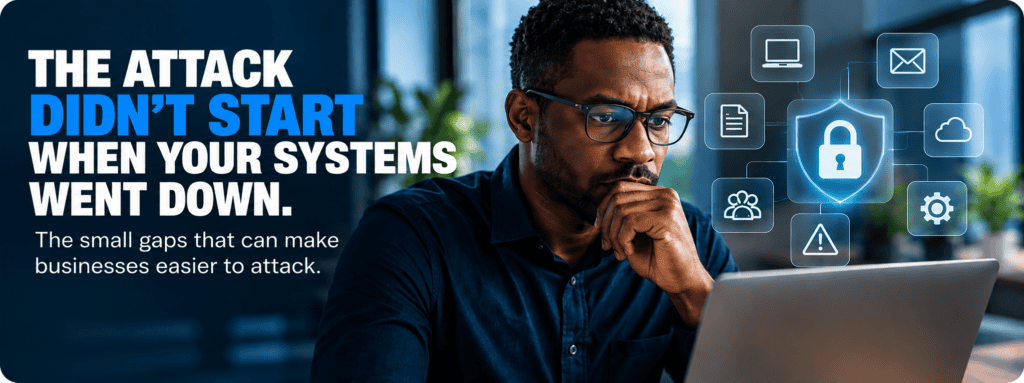
When a business experiences a cyber incident, attention naturally goes to the moment everything went wrong. Systems become unavailable. Employees can’t access what they need. Customers may be affected. Operations slow down or stop. That’s the visible part of the incident.
But it probably isn’t where the problem started. At Blu Networks, we’ve spoken before about downtime and the fact that technology failures rarely begin at the moment the business feels their impact. Cybersecurity is no different.
The conditions that allow an attack to succeed may have existed for weeks, months or even longer.
The Small Gaps That Increase Cybersecurity Risks
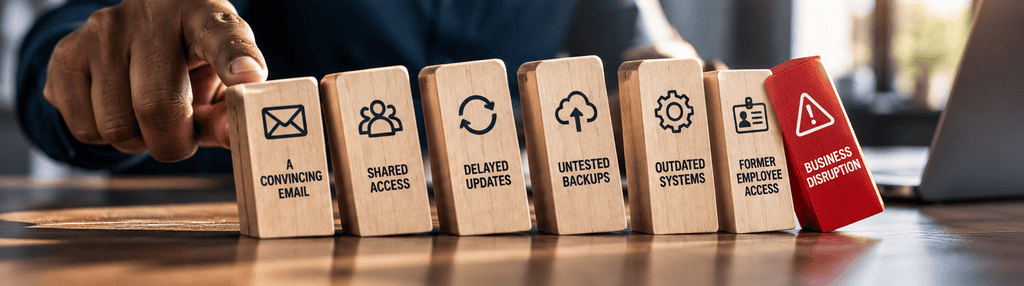
It may be software that hasn’t been updated. An account belonging to someone who no longer works with the company.
A shared password that was convenient at the time and simply became the norm.
A backup that exists but has never actually been tested.
A device connected to the network that nobody is actively monitoring.
Or an employee who receives an extremely convincing request that appears to come from someone they trust.
Individually, these things may not feel like a cybersecurity crisis.
That’s exactly the problem.
When everything is working, it’s easy to postpone the update, overlook the old account or assume the backup will work when you need it.
Cybersecurity isn’t only about responding well when something happens. It’s about reducing the opportunities that exist before it happens.
AI has changed the human side of cybersecurity
Businesses also must contend with attacks that are becoming increasingly sophisticated.
AI can help criminals create more convincing emails, imitate voices and develop social engineering attempts using information gathered about a company or individual.
That changes the conversation around employee awareness.
For years, employees have often been described as the weakest link in cybersecurity.
But what if the process is the weak link?
If one convincing email can change supplier banking information, the problem isn’t simply that an employee believed the email.
If a voice note that sounds exactly like the Managing Director can authorise an urgent payment, the problem isn’t simply that someone was fooled.
Businesses need processes that assume people can be deceived.
Verification, access controls, multiple levels of approval and clear procedures can provide another layer of protection when human judgement alone isn’t enough.
“We have backups” isn’t the end of the conversation
Backups are another good example.
Having a backup and being able to recover your business from one are two different things.
When was the last time your organisation tested its backups?
How long would restoration actually take?
What systems would need to come back first?
Who would make those decisions?
If those answers aren’t clear before an incident, you’re likely to be working them out when the business is already under pressure.
Cybersecurity is a business issue
Cybersecurity conversations can quickly become technical.
But the consequences rarely stay within the IT department.
A security incident can affect operations, revenue, customer relationships, reputation and the organisation’s ability to deliver its services.
That’s why business leaders don’t necessarily need to understand every technical detail of cybersecurity.
They do, however, need to ask better questions.
Who has access to our systems?
What are we not updating?
What happens when someone leaves the organisation?
How are unusual requests verified?
Are our backups actually recoverable?
What happens if our critical systems aren’t available tomorrow morning?
And where are we relying on assumptions rather than knowing?
Those aren’t questions to ask after an incident.
They’re questions to ask while everything is still working.
Because very often, the attack didn’t start when your systems went down.
The opportunity was there long before that.
This Cybersecurity Awareness Month, the message is Don’t Make It Easy for Them.
For businesses, that means looking beyond the obvious threats and paying attention to the everyday gaps across your people, processes and technology.
The best time to find those gaps is before someone else does.