When businesses invest in technology, the immediate priority is often functionality.
Can the new system process transactions? Will employees be able to access the applications they need? Can customers interact with the business more efficiently? Will the technology support growth?
These are important questions. After all, businesses invest in technology because they expect it to improve how they operate.
But there is another question that deserves just as much attention: Was this infrastructure designed with security in mind?
Building secure business infrastructure requires more than installing security software. It means considering how systems are selected, configured, connected and managed from the very beginning.
During a recent appearance on Straight Off the Bat, Blu Networks’ Director of Engineering and New Business, Sheldon Paul, emphasised that businesses should begin designing for cybersecurity from day zero.
He compared it to the work of an architect designing a building. Power and cooling are not considered after construction is complete. They are fundamental requirements that influence how the building is designed.
The same principle should apply to business technology.
Cybersecurity should not be treated as a separate phase that begins once everything else is operational. It should influence the decisions that shape an organisation’s entire IT infrastructure.
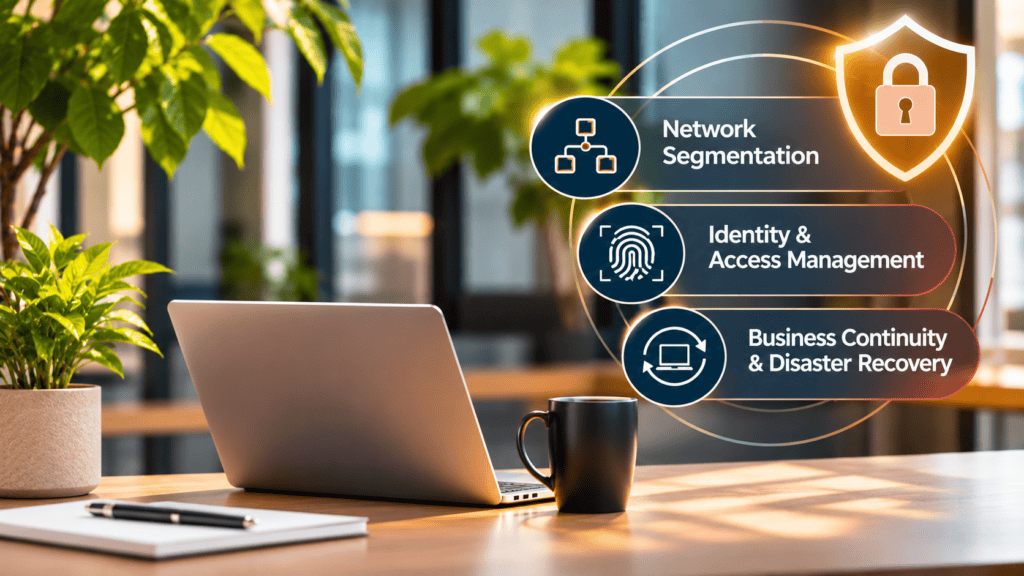
1. Network Segmentation: Are Your Critical Business Systems Properly Separated?
Consider the layout of an office.
Some organisations operate with open floor plans, while others have separate spaces for departments such as HR, payroll and operations.
A similar principle applies to business networks.
In cybersecurity, this is referred to as network segmentation and zoning.
Rather than allowing every system to operate within the same unrestricted environment, businesses can separate critical applications and resources based on their functions and security requirements.
For example, systems used for payroll, banking and other sensitive transactions should not automatically share the same level of network access as everyday business applications.
Why Network Segmentation Matters for Business Security
If one part of an organisation’s network is compromised, proper segmentation can help limit an attacker’s ability to move into other systems.
Without that separation, an incident affecting one device or application could potentially create problems across a much larger part of the business.
The objective is not to make technology more difficult to use. It is to design a secure business infrastructure where systems can operate effectively without exposing the entire organisation to unnecessary risk.
2. Identity and Access Management: Who Really Needs Access to Your Business Systems?
Another important consideration is identity and access management.
As businesses grow, employees are introduced to new applications, departments share information, and external service providers may require access to certain systems.
Over time, access permissions can become difficult to manage.
An employee may retain access to systems they no longer use. Multiple team members may share credentials. A service provider may have broader permissions than their responsibilities require.
These situations can create security weaknesses.
Sheldon highlighted the importance of treating identity as a critical part of an organisation’s security perimeter.
In practical terms, businesses need to know who is accessing their systems, what they can access and how their identities are verified.
Two Essential Access Controls for Business Cybersecurity
Multifactor authentication (MFA): Requiring an additional form of verification beyond a password before granting access.
Least-privilege access: Giving employees and other users access only to the systems and information required to perform their responsibilities.
These controls become particularly important when businesses use a combination of internal systems, cloud applications and externally hosted services.
The location of a system does not remove the need to control access to it.
A useful question for business leaders is whether access permissions are being deliberately managed or simply granted whenever someone requests them.
3. Business Continuity and Disaster Recovery: Can Your Business Recover?
Most businesses do not invest in technology expecting it to fail.
They expect their systems to remain available, their information to be accessible and their operations to continue without interruption.
But planning for cybersecurity also means considering what happens when those expectations are not met.
This is where recoverability, business continuity and disaster recovery become important.
Imagine discovering that a critical business application is suddenly unavailable.
How quickly could operations resume?
Would the business still have access to its information?
Who would be responsible for restoring the system?
If the application is hosted by an external provider, what support and recovery arrangements are in place?
These are not questions to consider for the first time during an incident.
Why Recovery Planning Is Essential to Secure Business Infrastructure
Businesses should understand where their data is stored, who has access to it and what arrangements exist for recovering systems and information following a failure.
This also means reviewing the commitments made by technology providers.
A solution may offer impressive features, but business owners should also understand the responsibilities of the provider, the available recovery options and the potential implications of prolonged downtime.
Business continuity depends on more than having technology that works today. It requires planning for how the organisation will operate when something goes wrong.
4. Building Secure IT Infrastructure Starts Before Implementation
One of the challenges businesses face is that technology decisions are often driven by immediate operational needs.
A department needs a new application. A company is expanding. Employees need remote access. A process needs to be automated.
The pressure is usually to get the solution working as quickly as possible.
However, decisions made during implementation can influence an organisation’s security posture for years.
Before introducing or expanding a system, businesses should be asking:
- How will this system connect to our existing infrastructure?
- What information will it store or process?
- Who will need access, and how will that access be controlled?
- Could a compromise affect other critical systems?
- How will the system be maintained, updated and recovered if necessary?
These conversations help businesses make more informed technology decisions.
They also reduce the likelihood of discovering later that an otherwise functional solution requires significant changes to address security concerns.
5. Secure Business Infrastructure Should Support Long-Term Growth
Cybersecurity is sometimes viewed as an additional expense or a technical responsibility that can be addressed after other business priorities have been met.
But security decisions are closely connected to operational efficiency, business continuity, customer confidence and the ability to grow.
A business may have modern software, reliable connectivity and systems that appear to function perfectly well. That does not necessarily mean the underlying infrastructure has been designed to manage security risks effectively.
At Blu Networks, we believe technology infrastructure should be approached as an interconnected environment, where functionality, security and resilience are considered together.
Whether an organisation is building its infrastructure from the ground up or reviewing systems already in place, the objective should be the same: create an environment that supports the business while protecting the systems and information on which it depends.
The most important time to consider cybersecurity is not after a problem occurs. It is when the decisions that shape your infrastructure are being made.
Blu Networks Consultancy Limited provides technology and infrastructure solutions that help organisations build secure, reliable and resilient IT environments.